Cloudflare Outages (2022-2026): A 5-Year Pattern Analysis
A data-backed analysis of Cloudflare outages from 2022 to 2026 using Cloudflare's official postmortems and status incidents. We break down recurring failure patterns, root causes, outage duration, and what operators should monitor first.
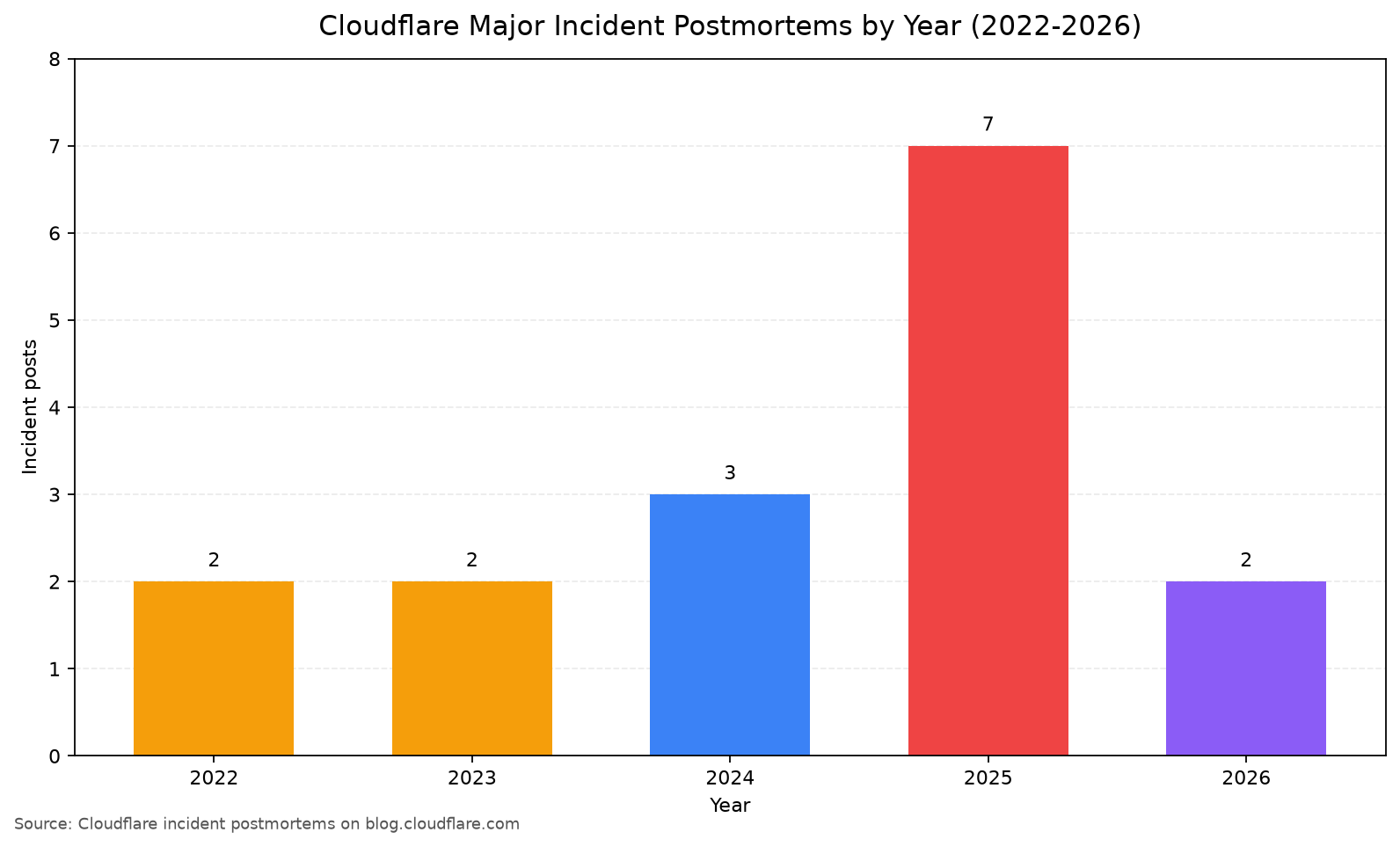
Cloudflare runs critical Internet infrastructure. When Cloudflare has an incident, the blast radius reaches far beyond one company. SaaS apps degrade, APIs time out, and login flows fail in multiple regions at once.
Cloudflare also publishes unusually detailed write-ups. That makes their outage history useful for pattern analysis.
This article analyzes Cloudflare outages over the last five years using Cloudflare's own incident posts and status history. The goal is simple: identify recurring failure modes you can design around.
Data Sources and Method
I used two primary sources:
| Source | What it provides |
|---|---|
Cloudflare incident postmortems on blog.cloudflare.com | Root cause, timeline, impact, remediation details |
Cloudflare status feed (cloudflarestatus.com/history.atom) | Recent incident titles and incident frequency by service area |
For the 5-year view, I used Cloudflare incident postmortem pages from 2022-2026 where Cloudflare explicitly labels a Cloudflare outage or incident.
Incident Set Used for 2022-2026 Analysis
| Date | Post title | Key impact detail from Cloudflare |
|---|---|---|
| Jun 21, 2022 | Cloudflare outage on June 21, 2022 | 19 data centers affected; Cloudflare says 4% of locations impacted 50% of global requests |
| Oct 25, 2022 | Partial Cloudflare outage on October 25, 2022 | Peak impact around 5% of HTTP requests failing with 530 |
| Jan 24, 2023 | Cloudflare incident on January 24, 2023 | 121-minute incident; broad product degradation |
| Oct 30, 2023 | Cloudflare incident on October 30, 2023 | 37-minute availability incident tied to Workers KV deployment tooling |
| Jun 20, 2024 | Cloudflare incident on June 20, 2024 | New DDoS rule increased latency and error responses |
| Sep 17, 2024 | Cloudflare incident on September 17, 2024 | Planned maintenance withdrew 15 IPv4 prefixes; Business sites impacted ~1 hour |
| Nov 14, 2024 | Cloudflare incident on November 14, 2024, resulting in lost logs | Logs outage lasting ~3.5 hours; Cloudflare states ~55% logs not delivered during impact window |
| Feb 6, 2025 | Cloudflare incident on February 6, 2025 | R2 outage and dependent services affected |
| Mar 21, 2025 | Cloudflare incident on March 21, 2025 | Multiple services including R2 saw elevated error rates |
| Jun 12, 2025 | Cloudflare service outage June 12, 2025 | Workers KV major impact; Cloudflare states 91% of KV requests failed during incident window |
| Jul 14, 2025 | Cloudflare 1.1.1.1 incident on July 14, 2025 | 1.1.1.1 outage lasting 62 minutes; root cause listed as internal config error |
| Aug 21, 2025 | Cloudflare incident on August 21, 2025 | Congestion toward AWS us-east-1 links caused broad service degradation |
| Nov 18, 2025 | Cloudflare outage on November 18, 2025 | Feature generation logic bug in Bot Management affected multiple services |
| Dec 5, 2025 | Cloudflare outage on December 5, 2025 | Significant traffic outage; Cloudflare reports ~25-minute duration |
| Jan 22, 2026 | Route leak incident on January 22, 2026 | Automated routing policy error leaked BGP prefixes from Miami router |
| Feb 20, 2026 | Cloudflare outage on February 20, 2026 | BYOIP customers saw BGP route withdrawals |
Year-by-Year Pattern Shift
The failure pattern changes by year.
| Year | Dominant pattern |
|---|---|
| 2022 | Core network and edge rollout risk |
| 2023 | Internal control-plane / deployment-tool risk |
| 2024 | Policy and maintenance-induced routing risk |
| 2025 | Dependency-heavy platform incidents (KV, R2, 1.1.1.1, upstream congestion) |
| 2026 (YTD) | BGP and route policy automation errors |
Cloudflare's postmortems show a clear shift from classic edge-network incidents toward platform dependency failures and automation misconfiguration.
Recurring Root Cause Families
Across this five-year window, the same root-cause families repeat.
1) Configuration and rollout mistakes
This is the most frequent class. Examples include:
- June 2022 outage from routing policy change process
- October 2022 partial outage during cache/tiered deployment rollback
- October 2023 incident tied to deployment tooling for Workers KV
- July 2025 1.1.1.1 outage from internal configuration error
- January 2026 route leak from automated routing policy configuration error
Cloudflare usually restores service quickly after rollback. The recurring issue is pre-deploy validation for control-plane or routing-impacting changes.
2) Routing and BGP control-plane fragility
Routing-related errors appear in 2022, 2024, and 2026 incidents.
Concrete examples from Cloudflare posts:
- September 2024 maintenance withdrawing 15 IPv4 prefixes
- January 2026 route leak from Miami
- February 2026 BYOIP route withdrawals
If your architecture depends on single-path anycast assumptions, these incidents are your warning.
3) Dependency concentration in shared services
2025 incidents show how many products depend on a few shared systems:
- Workers KV failure driving broad impact (June 2025)
- R2 gateway and credential-path failures (Feb + Mar 2025)
- 1.1.1.1 resolver outage from topology/config path
When shared internal services fail, the outage looks multi-product from the outside.
4) Upstream ecosystem exposure
August 2025 explicitly references severe congestion on links between Cloudflare and AWS us-east-1. That is not purely an internal Cloudflare bug. It is cross-provider coupling.
If your app stack sits on Cloudflare + AWS, this pattern matters directly.
Duration and Blast Radius: What the Numbers Suggest
From Cloudflare's own published incident descriptions in this set:
| Metric | Observed in dataset |
|---|---|
| Longest explicitly stated duration | 121 minutes (Jan 2023) |
| Short severe incident example | ~25 minutes (Dec 2025) |
| 1.1.1.1 outage example | 62 minutes (Jul 2025) |
| High error spike example | 91% Workers KV request failures during incident window (Jun 2025) |
| Partial but material global edge failure | 5% HTTP failures at peak (Oct 2022) |
The takeaway: duration alone underestimates severity. A 25-40 minute event on a shared dependency can produce more business impact than a longer low-rate degradation.
Recent Status Feed Signal (June 2026)
Cloudflare's recent status feed (latest 25 entries) skews heavily to regional network and Workers-family issues.
| Theme in latest 25 status incidents | Count |
|---|---|
| Network / regional events (Ashburn, India, airport PoPs) | 10 |
| Workers / KV / Durable Objects / Workers AI | 6 |
| Support, billing, roles, control-plane admin issues | 4 |
| SSL / certificate workflow issues | 2 |
| Other | 3 |
This aligns with the five-year pattern: platform and regional routing behavior dominate incident frequency.
What You Should Do with This Pattern
If you run customer-facing services behind Cloudflare, design around these specific failure families.
Monitoring priorities
| Priority | Why |
|---|---|
| Multi-region synthetic checks | Detect routing/regional incidents early |
| DNS + BGP-adjacent signal tracking | Catch prefix withdrawals and route anomalies |
| Dependency-specific checks (KV/R2/API paths) | Shared service failures don't always appear as full outages |
| Status-page-driven alert routing | Cloudflare incidents often start partial and regional |
Engineering priorities
- Keep fast rollback paths for edge and policy changes.
- Isolate critical paths from optional edge features.
- Run fallback behavior for API and auth paths when upstream degrades.
- Treat route policy automation as high-risk code with strict guardrails.
Key Pattern in One Sentence
Cloudflare's outage history over 2022-2026 shows the biggest operational risk is no longer raw hardware failure; it is high-speed configuration and routing automation interacting with shared platform dependencies.
That pattern is fixable. It starts with better pre-deploy validation, tighter blast-radius controls, and monitoring that sees regional partial failures before users do.
Method note: This analysis uses Cloudflare's official incident posts and status feed only. It does not claim to include every Cloudflare incident ever published; it analyzes the verified set of Cloudflare-labeled outage/incident postmortems from 2022-2026 plus current status-feed trend signals.